5th Nov, 2025
Caribbean Stakeholders Convene to Develop Action Plan to Strengthen Early Warning Systems for Heat and Dust-related Illnesses
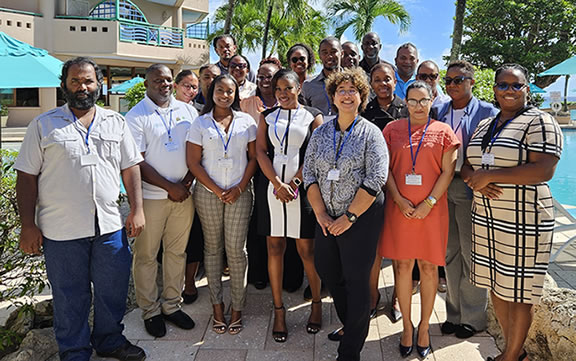
Bridgetown, Barbados, 4 November 2025 (PAHO/WHO) – Meteorological, surveillance and Climate Change and Health Focal Points from 12 Caribbean states met in Barbados last week to develop an action plan to strengthen Early Warning Systems (EWSs) for heat and dust-related illnesses. It is hoped that this will result in useful information being provided to health care workers and the public, before a heatwave or Sahara dust event occurs in the region.
The stakeholders learnt about the effects of these two climatic events on the health of the population, the challenges and surveillance gaps of Heat and Dust related illness in the Caribbean and heard lessons learned from countries piloting these systems.
PAHO/WHO Representative for Barbados and the Eastern Caribbean Countries, Dr Amalia Del Riego, expressed PAHO’s pleasure to have collaborated with the Caribbean Public Health Agency (CARPHA), the Caribbean Institute for Meteorology and Hydrology (CIMH) and other regional institutions to pilot climate-informed Early Warning Systems in several CARIFORUM countries.
These systems - especially the dengue predictive models now hosted on CARPHA’s platform - are not just innovations; they are lifelines. They integrate health surveillance data with climate information to empower timely, targeted public health responses. In fact, the dengue EWS predictive models now form the basis of a web-based application hosted on a CARPHA-based server… to enhance regional surveillance and health data management systems. This represents a major milestone in our technical collaboration and a leap forward in regional capacity to anticipate and respond to climate-sensitive diseases,
Dr Del Riego noted.
While explaining how EWS’s can assist a country in predicting events, Dr Laura Lee Boodram, Head of the Caribbean Regional Field Epidemiology and Laboratory Training Programme at CARPHA, noted that they must be both acceptable and credible.
The alerts that these systems generate have to be timely and relevant. But they also have to be compatible with different decision-making protocols in countries. So, if the systems are showing a high-risk signal, that is, an outbreak or event is predicted response and action must follow established country mechanisms. As technology advances and system accuracy increases we want to be able to better pinpoint epidemic prone areas and the populations that are going to be at risk. The key operating premise is, Early Warning for Early Action. By utilising systems such as these, Ministries of Health will be better prepared to mitigate the effects of climate change on both communicable and non-communicable diseases and conditions,
Dr Boodram explained.
In addition, in Barbados, Grenada, and Saint Lucia, the development of National Health–Climate Bulletins is enhancing our ability to communicate actionable insights. These bulletins, supported by workshops that build climate literacy and communication capacity, are helping health professionals translate complex data into life-saving decisions.
This important work, as well as the updating of regional and national climate and health bulletins, have been accomplished with the assistance of key development partner, the European Union, through the EU/CARIFORUM Climate Change and Health Project. In addition to Dr Boodram the facilitators also included Adrian Trotman, Cedric Van Meerbeeck, Roche Mahon and Jodi-Ann Petrie of the CIMH.
END
CONTACT:
Lisa Bayley - bayleylis@paho.org,
PAHO/WHO Office of the Subregional Program Coordination (Caribbean)
About the Pan American Health Organization:
The Pan American Health Organization (PAHO) works with the countries of the Americas to improve the health and quality of life of its population. Founded in 1902, it is the world’s oldest international public health agency. It serves as the Regional Office of WHO for the Americas and is the specialized health agency of the Inter-American system.
The PAHO Subregional Program is responsible for providing subregional technical cooperation and strengthening PAHO’s engagement with the Caribbean Subregional integration mechanisms, the Caribbean Community (CARICOM) and its various bodies and organs; and to build synergistic partnerships with the West Indies (UWI), among others. PAHO’s subregional technical cooperation specifically focuses on public health issues which would benefit from economies of scale and for which agreement on proposed collective responses and actions would produce a far greater impact rather than individual country responses. The Subregional Program also plays a role in coordinating among the different PAHO country offices.


